Sharing thoughts, ideas, and unsolicited advice about memoirs, journaling, and creative nonfiction.
The Deceptive Allure of Composition Books
Paper is the legacy of the late adopter


You’re walking the aisles of your local Walmart, and you’ve made it through that shopping list you scribbled on the back of a used envelope. It’s time to head to your car…
And then you see it: Past the pens and pencils and highlighters and Sharpies sits a shelf full of composition notebooks. Those 9.5" x 7.5", wide-ruled, 200-page wonders with covers that come in every color and design imaginable. Pristine writing books with twenty-five lines per page, each slim tome holds the promise of enough blank space to accommodate your limitless imagination. Stories, ideas, journal entries, sketches- you name it.
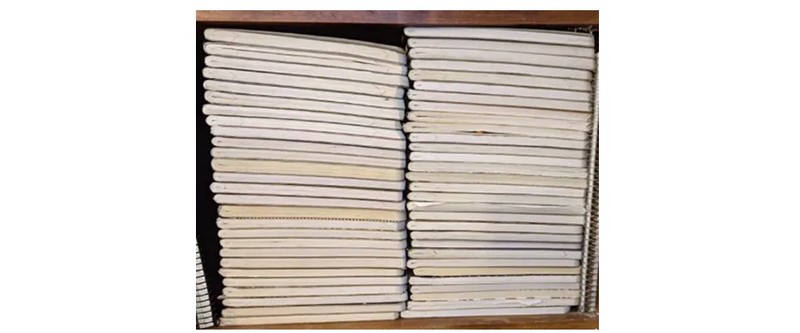
Against your better judgment you buy ten of them at fifty cents apiece. No matter that you already have a two-foot-high stack of empty comp books back at your place, untouched and unblemished, aside from a heavy layer of dust. No matter that you feel a stab of guilt every time you glance at them, anxiously engaged as you are in something besides the writing you should be doing.
But as you travel home, you pat the bag full of comp books, secure in the knowledge that now you’re prepared for anything- lack of funds, the next plague- or worse, a toilet paper shortage.
What you’re not ready for is what will happen once all those damned books are full.
Don’t get me wrong. I love composition books as much as the next writer. Being a late adopter who loves paper- due to lingering doubts about the infallibility of the Cloud, flash drives and other media storage devices- I’ve relied on comp books for years, though I do also compose stories and the like on my computer. But I prefer the comp book’s portability, and the fact that it doesn’t rely on batteries or electricity, not to mention its ability to continue functioning if dropped on a concrete floor or run over by car tires.
The trouble with comp books is that if one doesn’t manage entries well, things can get out of hand, and rather quickly. What starts out as a permanent, visual record of one’s creativity can become a black hole, a bottomless abyss where the words one has been writing can disappear. Well, maybe not bottomless, but still darned hard to locate.
My trouble began in 2007. While taking a slew of creative writing courses, I strayed further and further from my beloved journals, the writing habit instead sustained by reams of unattached papers filled with drafts and ideas and assignments, none of which those journal pages could accommodate.
So, I bought a comp book.
Then another.
And another.
Since I had a bad habit of buying most any sort of printed material that would help fill my already overloaded bookcases, the comp books looked good there- evidence to the world and self that I was finally a Writer.
At first, I filled and dated every entry in Comp Book #1. Some entries were brief, others going on for twenty pages. But I loved the flexibility and the freedom.
Book #1 filled, I moved on to Book #2.
And the more I wrote, the more varied the topics became.
And, as time passed, the more difficult it was to go back and find things I’d written. But seeing as there were only three or four books involved, I stopped worrying.
Time passed. I would fill part of a book, then yield to impulse and start a new comp book devoted to another great project I’d dreamed up. But after ten or twenty pages were filled, I lost interest and returned to one of the previous books.
And so, Pandora’s writing box was opened, never to be closed again.
More time passed. Eventually, Book #15 was filled, and with it the realization that- much like the people in Noah’s time, when the rain started falling and just wouldn’t let up- I had a problem. Not only could I not remember where this or that story had gone to, I’d forgotten that a lot of my writing- whatever it was- even existed. I was looking at reams of paper, pages full of mysteries.
To compound the trouble, I’d gone back, during previous years, and filled in spaces in any book where there were scores of empty pages. And though I’d dated those additional entries, chronological order had gone to hell in a fleet of tattered handbaskets.
Thinking an Excel spreadsheet would solve the problem, I dug in. At first, the voyage of discovery was exciting. I was running into some good stuff, along with a lot of dreck, and started entering topics and dates in the spreadsheet. Weeks later, I finished surveying all fifteen books and felt so proud of myself. I now knew where everything was.
But then I slacked off with my tracking duties. More years passed, as Books #20, #30, #40 and #50 were filled up or only partially written in. Now it wasn’t just a matter of where this or that story or idea had gone to, but where the hell the book was that I’d written it in.
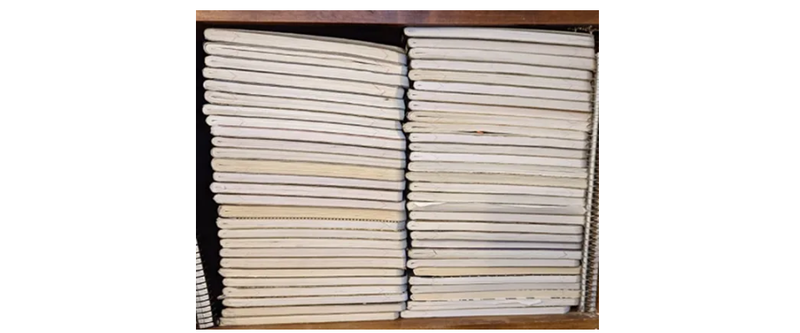
And so the search began. Gathering errant comp books from every corner of my library, I numbered each binding from 1–50, discovering to my chagrin that chronology was useless as an organizational aid.
File Manager merely laughed when I turned to it in desperation, files and folders by the hundreds arrayed in front of my glazed eyes, a stark reminder of why I’d started a spreadsheet in the first place.
But since I was there, I had the sense to place a number in front of each document file name. Though it was drudge work, it seemed to make sense- until I saw what it did to the spreadsheet. The sheet was so cluttered that it now needed its own index. Yes, the system I’d tried to set up was devouring itself.
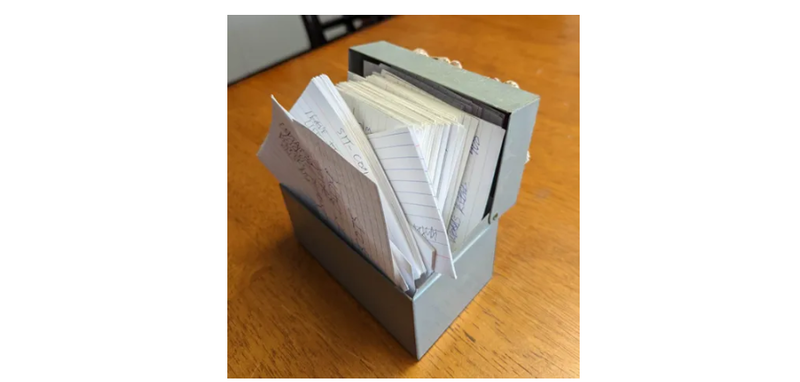
And so it was that I sat down at a table in the garage, several months ago, comp books piled to one side, spreadsheets to another, and a stack of empty index cards in front of me. One topic heading after another was added to each respective index card, along with corresponding ID numbers and document titles.
I’d like to say that the finished product solved all my finding problems.
I’d like to say that though the final solution wasn’t perfect, it did help a lot.
Instead, I now have an index card organization problem…
Comments and questions are required welcomed. Ask me anything about memoirs, journaling or personal histories.

Comments
No comments yet. Be the first to comment!