

Sharing thoughts, ideas, and unsolicited advice about memoirs, journaling, and creative nonfiction.
Blue Voyage: Conrad Aiken's Novel Plumbs the Depths of Human Love
America's Poet Laureate delivers a psychological, semi-autobiographical puzzle for the ages
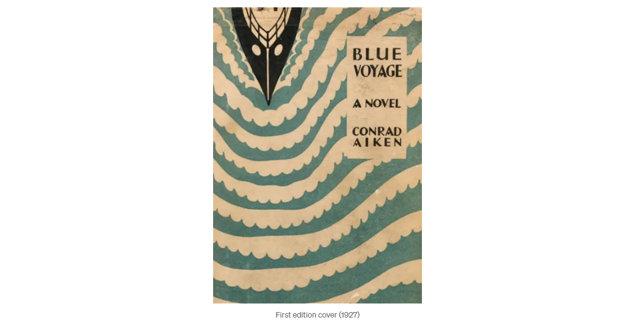

It’s 2:11 am, and I just finished reading Conrad Aiken’s “Blue Voyage,” for the third time. But as I placed the book on my nightstand, it felt as if I was reading Aiken’s novel for the first time.
Ever had that happen? You read something and it doesn't make sense- so you give up on it.
Or you make it to the end, but find that somewhere along the line, you started skipping sentences, then paragraphs, then half a chapter here and there in order to reach the finish line- after which you set the book down, feeling ashamed, as if you’ve cheated yourself and the person who went to all the trouble to write the book.
I’d first become acquainted with Aiken’s work while reading the incredible “Mr. Arcularis.”
The tale left me with the same feelings I had after reading “The Lottery,” by Shirley Jackson: a mixture of revulsion, amazement, and a sense that the outcome was inevitable- in a perverse way. And if an author’s work had that kind of an effect on me, I had to learn more.
I tend to go overboard when I happen upon a good thing. And so, with impulse control circuits disabled, I searched for and bought: -
“Ushant,” (Aiken’s memoir)
“The Collected Novels of Conrad Aiken”
“The Collected Short Stories of Conrad Aiken”
“Conrad Aiken: A Life of His Art”
“The Reviewer’s A.B.C.”
“An Anthology of English and American Poetry” (despite the fact that Aiken’s contribution to the 561-page tome on poetry is only four-and-a-half pages long)
I read short bios of Conrad’s life, as well as critical reviews of his poetry and stories. What I came away with was the description of a man in full- a writer who became so accomplished with his poetry that he was chosen to serve as the United States Poet Laureate from 1950–1952; a man whose three children became writers; a man who married three times, struggling his entire life with crippling emotional challenges stemming from a tragic childhood event.
While I don't remember in which order I took Aiken’s work, I eventually got around to “Blue Voyage.”
Published in 1927, the story involves William Demarest, a failed writer (by his own estimation), who embarks on an eight-day ocean voyage from New York to London. Though a veteran of nearly a dozen such trips, he looks upon this one as a chance to deal with his obsession about Cynthia, his lady friend from a similar voyage a year earlier. Suffering from the slings and arrows of unrequited love, he seems content to endlessly fantasize about a woman he wants, but has no clue how to connect with.
But Fate has other plans.
Early in the trip, William sneaks up to the First-Class deck, on a dare. While there, he’s shocked to see Cynthia, the young lady he’s been madly in love with. Is it providence or coincidence that they’ve met? Demarest wonders, as he calls out to her.
They talk for a while, which is when William realizes she hasn’t read the two long, passionate letters he recently wrote to her. Though she remains pleasant, Cynthia tells him that she’s engaged to be married. Crushed, William offers a polite goodbye, then retreats to the lower deck and a severe depression.
But once this conflict kicks into high gear, it’s apparent that it won’t be a simple matter of will-William-get-the-girl- which is when I began struggling with the story- for Aiken’s style, form and intent are anything but simple.
A tale that initially seemed straightforward tale is soon wallowing in prose; POV switches between second person and third, with some first person tossed in, on occasion; snatches of poetry confound; literary references to mythology and the arcane are lost on me.
As the narrative slowly took on a dreamlike quality, I found myself walking into the middle of conversations, stories, and relationships. And though the voyage is supposed to be of eight days duration, Aiken continually references the Infinite- his characterization of the ocean and any trip into or across it.
Subsequently, it seems that there’s no beginning and no end; as if we and the passengers have been on the ship forever. And though countries are mentioned, the World is this ship- a floating island that’s isolated from everything in the past, present or future.
Throughout the first and second readings, philosophical rabbit holes caused me to jot down notes in an effort to make sense out of Aiken’s musings:
Recurring images/thoughts of crucifixion: Why didn’t Aiken speak of self-sacrifice in terms of martyrdom or masochism? To be crucified is not necessarily something that one submits to willingly, like a martyr, but ending up on the cross has never been something one couldn’t avoid, if they put their mind to it. Is Aiken implying that a commitment to something like marriage is only worthwhile if someone is willing to give up freedom and comfort (since matrimony or avoidance of the same figures prominently in this tale)?
Loneliness, sex, death, eternity, spirituality, and religion- they’re all there in one form or another. And all too soon, I found myself adrift, like Demarest. A lonely man bedeviled by grief and regret concerning Cynthia, William D indulges in flashbacks, internal and external dialogue, dreams, and letters; meanwhile, the stream-of-consciousness sections sent me into a mental daze.
But while reading “Blue Voyage” a third time, everything started making sense. Maybe it’s because I slowed down. Like the works of Henry James, Aiken’s writing only reveals its treasures to me when I slow the pace and take sentences one at a time.
And as I became accustomed to the pace, that thirty-three-page stream-of-consciousness chapter, which constitutes a pivotal point smack dab in the middle of the book, made sense; in the process, I got locked into the narrative, riding along at the story's pace instead of trying to force the words to fit my thought process.
By “riding along,” I was able to better understand the role the secondary characters played in the book- one that revolves around marriage, and how much of a failed institution it is for the passengers Demarest is associating with.
There’s the geriatric Mr. Smith. His wife having abandoned him several weeks after their honeymoon (decades earlier), Smith becomes more pathetic than lecherous, the personification of regret. Now a desperate old man, he’s a creeper- on the prowl for women, but more talk than action.
Smith flirts when he should be a gentleman, charms when he should be genuine, and is friendly when he should instead be a friend. Self-centered and lonely, he’s the future man that Demarest sees himself doomed to become- unless he can overcome an inferiority complex that stokes his crippling self-doubt and lack of confidence around women.
Smith is the closest thing to a friend that Demarest has on the ship, yet the elderly man is more interested in being a Casanova wanna-be, a co-conspirator in the quest for sex. But Smith has nothing to offer William Demarest; Mr. Smith is knocking on death’s door, or might as well be, so filled with denial about his has-been status that he continually fails to connect with the opposite sex.
Marriage doesn’t fare well in the book.
Smith is victim of a failed marriage.
William Demarest (the main character) is a confirmed but unfulfilled bachelor.
Cynthia, William’s frigid ex-fiancé, dumps him.
One of the ship’s staff is married, but ready, willing and able to cheat on his wife with unsuspecting passengers.
The Major stays away from his wife for months at a time, so he can enjoy other womens’ company.
Silberstein the hedonist- William’s intellectual equal and the closest thing he has to a friend- will never marry, content to play the sexual field forever.
The alluring Mrs. Faubion is married, but on the cusp of a divorce, due to her infidelity.
And Faubion’s traveling companion will never marry, content to giggle, flirt and revel in the party life.
None of the characters in Blue Voyage appear with their spouses- and of the lot, perennial bachelor Demarest seems the closest to desiring a meaningful relationship. Yet he seems unable to find a mate, whipsawed as he is between the sexual perks of empty flings and the commitment that matrimony entails.
It was when I saw a lot of myself in Demarest that the story really opened up. I was reminded of that time in my life- a mere seven years away from forty- when I experienced a crisis: if things went on the way they had, I would never marry. And why? Because…
Like Demarest, I had failed to connect at more than an immature or primitive (carnal) level with the scores of women I’d dated throughout a ten-year period.
Like Demarest, I was careening back and forth between lust and the desire for true and lasting romance.
Like Demarest, I struggled with self-doubt and a crippling lack of confidence- to the point that I despaired of ever finding true love.
And like Demarest, I was slowly but quietly going mad.
The question was, who would come along and rescue me (or William Demarest) from the emotional, sexual and spiritual oblivion that loneliness promised?
I could go on and on, for “Blue Voyage” is one of those books of which another could be written; there is so much going on, the author’s psyche embedded everywhere one looks. But by book’s end, the main issues are resolved, justice is served, and readers can walk away with a smile on their faces.
Aikens’s infidelity, wordplay, poetry career, musings on religion, witnessed deaths in his family, and father-son dysfunction; it’s all there, and put together in such a way that I’ll never fully get to the bottom of it- unless I read it a fourth time.
Comments and questions are required welcomed. Ask me anything about memoirs, journaling or personal histories.

Comments
No comments yet. Be the first to comment!